Erosion and Abrasion in Oil & Gas Flow-Control Components
Understand particle erosion and abrasive wear in flow-control components, including damage patterns, failure analysis, and ways to reduce wear.

Tungsten carbide components are widely used in industrial systems exposed to severe abrasion, particle erosion, impact, pressure, sliding wear, corrosive media, and demanding thermal-mechanical conditions.
These technical guides provide OEMs, engineers, maintenance teams, and equipment manufacturers with practical information for specifying tungsten carbide wear components for mining, oil & gas, steel and metal processing, cement and power, and other high-wear industrial applications.
This resource hub focuses on wear mechanisms, carbide grade selection, component design, material optimization, and manufacturing considerations that influence service life and performance in severe operating environments.
High-wear environments are defined by actual operating conditions rather than industry classification alone. Identifying the dominant wear mechanism—and any interacting wear mechanisms—is an important first step in selecting the appropriate carbide grade, geometry, surface condition, and component design.
| Wear Mechanism | Typical Causes | Typical Components |
|---|---|---|
| Abrasion & Sliding Wear | Hard particles, sliding contact, contaminated media | Bushings, sleeves, liners, guides, wear inserts |
| Particle & Fluid Erosion | High-velocity fluids, entrained solids, slurries | Nozzles, valve trim, choke components, orifices |
| Impact & Mechanical Loading | Shock loading, particle impact, repeated mechanical loads | Inserts, cutters, dies, tooling and wear components |
| Thermal-Mechanical Wear | Elevated temperatures, thermal cycling, mechanical loading | Valve components, tooling and process wear parts |
| Corrosion-Wear | Corrosive media combined with abrasion or erosion | Valve, pump, seal and process-flow components |
| Combined Wear | Multiple wear mechanisms acting simultaneously | Custom severe-service wear components |
In many industrial applications, more than one wear mechanism occurs at the same time. Grade selection should therefore consider the complete operating environment rather than hardness or wear resistance alone.
Tungsten carbide requires different design considerations from conventional steels because of its very high hardness, high compressive strength, and comparatively limited tolerance for tensile stress and certain impact conditions.
Successful carbide component design requires the material grade, component geometry, manufacturing process, and assembly method to be considered together.
Not all tungsten carbide grades perform the same way. WC grain characteristics, binder type and content, additives, microstructure, manufacturing control, and component geometry can significantly influence wear resistance, toughness, corrosion behavior, and overall service performance.
There is no single “best” tungsten carbide grade. The appropriate material depends on the dominant wear mechanisms and actual operating conditions.
| Operating Condition | General Material Direction | Primary Engineering Objective |
|---|---|---|
| Abrasion-Dominant | Finer WC structure and wear-oriented binder system | High hardness and abrasion resistance |
| Abrasion + Mechanical Loading | Balanced WC structure and binder content | Balance wear resistance and toughness |
| Impact-Dominant | Toughness-oriented carbide grade | Reduce chipping and fracture risk |
| Corrosive / Erosive Flow | Corrosion-resistant binder system where appropriate | Balance erosion and corrosion resistance |
| Combined Severe Service | Application-specific grade formulation | Balance multiple performance requirements |
These are general engineering directions rather than fixed grade specifications. Final grade selection should be based on application-specific operating data.
When specifying a tungsten carbide grade, engineers should consider:
Increasing hardness does not automatically improve component life. In applications involving impact, vibration, stress concentration, or complex loading, an excessively wear-oriented grade may increase the risk of chipping or fracture.
Grade selection should consider abrasion, sliding wear, contact pressure, lubrication, alignment, and the possibility of impact or vibration.
Selection should consider particle erosion, pressure differential, sealing requirements, corrosive media, impact conditions, and dimensional stability.
These applications may involve abrasion, erosion, corrosion, sliding contact, pressure, and thermal-mechanical effects. Material selection should reflect the actual combination of operating conditions.
Grade selection should balance edge retention, wear resistance, compressive loading, toughness, workpiece material, tooling geometry, and operating conditions.
Tungsten carbide and hardened steel have different mechanical characteristics and should be selected according to the application rather than hardness alone.
| Property | Tungsten Carbide | Hardened Steel |
|---|---|---|
| Hardness | Very high | Moderate to high |
| Abrasion Resistance | Excellent | Application-dependent |
| Erosion Resistance | Excellent with appropriate grade selection | Application-dependent |
| Compressive Strength | Very high | High |
| Impact Tolerance | Grade- and geometry-dependent | Generally more ductile |
| Dimensional Wear Resistance | Excellent | Lower under severe abrasive conditions |
| Corrosion Resistance | Binder- and environment-dependent | Alloy- and environment-dependent |
| Manufacturing / Machining | Specialized processing required | Generally easier to machine |
| Initial Component Cost | Typically higher | Typically lower |
| Lifecycle Economics | Can be favorable in severe-wear applications | Can be favorable where wear severity is lower |
In suitable applications, tungsten carbide can extend service intervals, reduce replacement frequency, and lower downtime exposure. However, lifecycle performance depends on correct grade selection, component design, assembly, and actual operating conditions.
The most useful comparison is therefore not simply carbide versus steel purchase price, but cost per operating hour and total lifecycle performance.
When original drawings are unavailable, existing components can provide a starting point for dimensional evaluation, material review, and replacement-part development. Reverse engineering can also support applications where an existing steel or carbide component requires improved wear performance.
For performance upgrades, the objective should not be to reproduce a worn component without evaluation. Wear patterns, failure modes, operating conditions, material selection, and geometry should be reviewed together to identify opportunities for improved service life.
Selecting the appropriate tungsten carbide solution requires more than choosing a hardness value or standard grade. EnduraCarbide evaluates material characteristics, component geometry, tolerances, surface requirements, manufacturing processes, and actual service conditions to develop application-specific carbide components.
For technical evaluation, provide:
Submit your drawings, samples, or technical requirements for an engineering review.
Industrial equipment used in oil & gas, mining and mineral processing, cement and aggregates, power generation, steel and metal processing, and other demanding industries can be exposed to multiple forms of wear.
Abrasion, particle erosion, impact, sliding contact, slurry flow, repeated mechanical loading, elevated temperatures, thermal cycling, and corrosive process media can progressively remove material, alter critical dimensions, reduce equipment efficiency, increase maintenance requirements, and shorten component service life.
In real industrial equipment, these conditions rarely act independently. A component may experience abrasion together with impact, erosion together with corrosion, or mechanical loading together with elevated-temperature exposure.
Understanding the dominant wear mechanism—and the interaction between multiple mechanisms—is therefore the first step in selecting an appropriate material, carbide grade, component geometry, and wear-protection strategy.
This guide examines the principal wear conditions encountered in severe-service industrial applications:
It also explains how to identify the dominant wear mechanism and why different wear conditions require different material and tungsten carbide strategies.
Industrial wear is the progressive loss, displacement, or degradation of material from a component surface during operation.
Wear can result from:
Chemical degradation can also interact with mechanical wear. For example, corrosion may weaken or remove a surface layer while abrasion or erosion continuously exposes fresh material.
Wear can become critical in:
Wear severity depends not only on the material itself but also on particle characteristics, velocity, load, impact angle, temperature, process chemistry, geometry, surface condition, component support, and system design.
For this reason, simply specifying a harder material does not necessarily solve a wear problem.
Abrasive wear occurs when hard particles, asperities, or rough surfaces move across a component surface and progressively remove material through mechanisms such as micro-cutting, plowing, scratching, or repeated surface deformation.
Sliding wear occurs between contacting surfaces and may interact with abrasive contamination, contact pressure, lubrication conditions, surface finish, and alignment.
Abrasion severity can depend on:
High hardness can be beneficial where abrasive material loss controls component life.
Tungsten carbide can provide high resistance to abrasive and dimensional wear, but the appropriate carbide grade depends on the complete operating environment.
Where abrasion occurs together with significant impact or mechanical loading, selecting the hardest available carbide grade may not provide the best performance. Toughness, geometry, wall thickness, support, and assembly conditions must also be considered.
Particle erosion occurs when moving particles carried by liquids or gases repeatedly strike or move across a component surface and progressively remove material.
Unlike simple sliding abrasion, erosion is strongly influenced by flow conditions and particle impact behavior.
Particle erosion depends on:
Tungsten carbide can provide substantially higher resistance to particle erosion than many conventional metallic materials when the carbide grade, component geometry, flow conditions, and mechanical loading are properly considered.
However, erosion resistance should not be evaluated from hardness alone.
Flow-path geometry, localized turbulence, impact angle, particle characteristics, carbide grade, binder system, and component support can all influence performance.
Erosion becomes particularly important where small amounts of material loss change critical flow geometry, sealing surfaces, or operating clearances.
Impact-related wear and mechanical damage can occur when repeated striking, shock loading, particle impact, vibration, cyclic loading, or mechanical contact produces localized deformation, chipping, cracking, fatigue, or material loss.
Impact frequently occurs together with abrasion rather than as an isolated wear mechanism.
Impact resistance should not be evaluated by hardness alone.
Important considerations include:
Steel generally provides greater ductility and tolerance to severe impact, tensile stress, bending, and deformation than tungsten carbide.
Tungsten carbide may still be valuable where impact occurs together with severe wear, but successful application requires the appropriate balance of:
In many applications, a steel structure combined with localized carbide wear protection provides a better engineering solution than a fully carbide component.
Slurry wear occurs when solid particles suspended in a liquid interact with component surfaces.
It is not necessarily a single wear mechanism.
Slurry service commonly combines abrasion and erosion, while impact and corrosion may also contribute depending on the operating environment.
Slurry wear depends strongly on:
Slurry applications should be evaluated as complete operating systems rather than treated automatically as simple abrasion problems.
For example, a component experiencing predominantly sliding abrasion may require a different carbide strategy from one exposed to high-velocity slurry impingement.
Where process chemistry is aggressive, binder selection may also become important.
The correct carbide grade therefore depends on the relative contribution of abrasion, erosion, impact, corrosion, and mechanical loading.
Temperature itself is not a wear mechanism.
However, elevated temperature, temperature gradients, thermal cycling, oxidation, and mechanical loading can interact with conventional wear mechanisms and change component performance.
These interactions are referred to here as thermal-mechanical wear conditions.
Actual component performance depends on:
The temperature of the process material should not automatically be treated as the temperature experienced by the wear component.
For tungsten carbide components, additional considerations can include:
There is no single universal temperature threshold at which tungsten carbide should automatically replace steel.
Material selection must be based on the actual temperature, wear mechanism, mechanical loading, atmosphere, component geometry, and assembly design.
Corrosion-wear occurs when chemical or electrochemical degradation interacts with mechanical wear such as abrasion, erosion, or sliding contact.
Mechanical action may remove protective surface films and expose fresh material, while corrosion can weaken the surface and increase its susceptibility to further mechanical damage.
Where particle or fluid erosion interacts with corrosion, the condition is often described as corrosion-erosion.
Tungsten carbide should not be considered universally corrosion-resistant.
Corrosion behavior depends strongly on the binder system and actual chemical environment.
Cobalt-bonded, nickel-containing, and other carbide binder systems can behave differently under particular process conditions.
Material selection should therefore consider both mechanical wear and chemical exposure rather than evaluating either condition independently.
In actual industrial equipment, wear mechanisms rarely occur completely independently.
Typical combinations include:
The dominant mechanism can also change during operation as:
This explains why material selection based on a single property—particularly hardness—is rarely sufficient for severe-service applications.
The complete wear system must be evaluated.
Correctly identifying the dominant wear mechanism is one of the most important steps in solving a wear problem.
The appearance of a failed component can provide useful evidence, but visual inspection alone may not identify the complete cause.
A structured evaluation should consider the following.
Look for characteristics such as:
Different patterns can suggest different wear mechanisms.
Determine whether damage is concentrated:
The location of wear can be as important as the amount of wear.
Evaluate:
Ask whether the component primarily:
A component that wears uniformly presents a different engineering problem from one that fractures prematurely.
Do not assume there is only one cause.
For example:
Abrasion + impact may require greater toughness than abrasion alone.
Erosion + corrosion may require consideration of both hardness and binder chemistry.
Wear + thermal cycling may require evaluation of differential thermal expansion and assembly stresses.
The objective is to determine which mechanism primarily controls component life and which secondary mechanisms influence the failure.
There is no universally best wear-resistant material or tungsten carbide grade.
Different wear mechanisms place different demands on the material and component.
| Wear condition | Important engineering considerations |
|---|---|
| Severe abrasion | Hardness, carbide microstructure, particle characteristics, wear allowance |
| Particle erosion | Grade, particle velocity, impact angle, flow geometry, dimensional retention |
| Impact + wear | Toughness, geometry, support, edge design, stress distribution |
| Slurry wear | Abrasion/erosion balance, particles, velocity, chemistry, binder system |
| Corrosion-erosion | Binder system, process chemistry, particles, velocity, temperature |
| Thermal-mechanical conditions | Temperature, thermal cycling, expansion, joining, mechanical loading |
| Sliding/contact wear | Hardness, surface finish, contact pressure, alignment, clearance |
| Combined mechanisms | Balance of properties based on the complete operating environment |
A material optimized for maximum hardness may perform well under severe abrasion but may be less tolerant of impact, tensile stress, or unfavorable geometry.
Similarly, a tougher material may resist mechanical damage but experience faster abrasive dimensional loss.
For this reason, carbide selection should consider:
The engineering objective is not to maximize one material property.
It is to find the appropriate property balance for the actual failure mechanism.
Different equipment within the same industry can experience very different wear conditions. The following profiles therefore represent common examples rather than fixed industry-wide classifications.
Common conditions include:
Sand, drilling solids, produced solids, high-velocity fluids, pressure differentials, and corrosive media can create complex wear conditions in valves, choke components, nozzles, sleeves, bushings, pumps, and other flow-control or downhole components.
Common conditions include:
Crushing, grinding, conveying, slurry transport, classification, and mineral-processing systems can expose components to different combinations of these mechanisms.
Common conditions include:
Rolling, forming, guiding, cutting, and other metal-processing operations require material selection based on the actual combination of contact pressure, wear, temperature, geometry, and mechanical loading.
Common conditions include:
Crushing, grinding, classification, conveying, clinker handling, and other process areas can require different wear-protection strategies.
Common conditions include:
The dominant mechanisms depend strongly on the type of power-generation system and the specific component.
Wear-resistant material selection requires more than choosing the material with the highest hardness.
Important material and design characteristics can include:
Steel, tungsten carbide, and other engineered materials each provide different advantages.
Steel can provide structural toughness, ductility, manufacturability, and repairability.
Tungsten carbide can provide exceptional localized resistance to abrasion, particle erosion, and dimensional wear when the carbide grade and component design are appropriate.
In many applications, an effective solution combines a steel structure with tungsten carbide:
The correct question is therefore not simply:
The more useful engineering question is:
Effective wear control begins with understanding the actual operating conditions.
A structured engineering approach includes:
Depending on the application, the solution may involve:
The objective is to engineer the complete wear system rather than simply maximize material hardness.
When wear mechanisms are not properly identified or addressed, possible consequences include:
The significance of each consequence depends on the component, equipment, and operating environment.
Understanding the actual failure mechanism can help maintenance and engineering teams address the root cause rather than repeatedly replacing worn components with the same material and design.
Industrial wear is not a single phenomenon.
It results from interacting mechanical, fluid-dynamic, thermal, and sometimes chemical mechanisms that vary according to equipment design and actual operating conditions.
Determining whether abrasion, particle erosion, impact and mechanical loading, slurry wear, thermal-mechanical effects, corrosion-wear, or a combination of these mechanisms controls component life is the first step toward selecting an appropriate engineering solution.
Reliable wear performance depends on the interaction between:
The goal of wear engineering is not simply to select the hardest available material. It is to match material properties, component design, and manufacturing requirements to the actual wear mechanisms and operating environment.
A structured, application-specific approach can help extend service intervals, improve maintenance predictability, and reduce the lifecycle impact of wear-related component replacement.
If an existing component is experiencing rapid wear, erosion, dimensional loss, chipping, cracking, or repeated premature failure, provide the available application information for technical review.
Useful information includes:
These details can help determine whether the primary issue is related to abrasion, erosion, impact, corrosion, thermal-mechanical conditions, component geometry, material selection, or a combination of factors.
Response within 24 hours • NDA available • Technical review included
Cemented carbide is an important engineering material for cutting tools, metal forming, wear-resistant components, flow-control parts, mining components, dies, bushings, sleeves, nozzles, and other demanding industrial applications.
Rather than being a single material, cemented carbide is a family of composite materials consisting primarily of a hard carbide phase—typically tungsten carbide (WC)—combined with a metallic binder such as cobalt (Co) or, for certain applications, nickel-based binder systems.
Its performance can be adjusted through WC grain characteristics, binder type and content, additives, formulation, sintering conditions, density, microstructure, and subsequent finishing processes.
Selecting the correct carbide grade therefore does not mean choosing the hardest available material. It means finding the appropriate balance of wear resistance, toughness, corrosion resistance, mechanical strength, dimensional stability, and manufacturability for the actual operating conditions.
The performance of tungsten carbide components is strongly influenced by several interconnected material variables:
These factors should be considered as a system rather than evaluated independently.
WC grain size has an important influence on hardness, wear resistance, toughness, and fracture behavior.
In general, finer WC structures can provide higher hardness and improved resistance to certain forms of abrasive wear. They can also support fine edges and precise geometries in applications where dimensional control is important.
Coarser WC structures are often considered where greater toughness or resistance to mechanical damage is required.
However, grain size alone does not determine performance. Binder content, binder distribution, carbide formulation, component geometry, loading conditions, and manufacturing quality can significantly affect the behavior of the finished component.
For this reason, simply specifying “fine grain” or “coarse grain” is rarely sufficient for demanding engineered applications.
The metallic binder holds the WC structure together and has a major influence on the balance between hardness and toughness.
For conventional WC-Co cemented carbides, increasing cobalt content generally increases toughness while reducing hardness and, in many abrasive environments, wear resistance.
Lower binder contents are commonly associated with higher hardness and wear resistance, while higher binder contents may be selected where impact, shock, vibration, or mechanical loading requires greater toughness.
This is a fundamental engineering tradeoff:
Higher hardness → generally greater wear resistance, but lower tolerance to impact and tensile stress
Higher toughness → generally greater resistance to mechanical damage, but lower hardness
The optimum balance depends on the actual failure mechanism.
Cobalt is widely used as the binder in tungsten carbide because it provides a useful combination of strength, toughness, and manufacturing performance.
However, some operating environments require alternative binder systems.
Nickel-containing or nickel-based cemented carbides may be considered for applications where corrosion resistance is an important design requirement. Binder selection should be based on the actual process media, temperature, mechanical loading, wear mechanism, and required material properties.
No binder system should be considered universally superior.
One source of confusion in carbide selection is the difference between cutting-tool application classifications and material grades used for engineered wear components.
For machining applications, ISO application groups are commonly used to organize cutting materials according to the workpiece material and machining conditions.
Common groups include:
Within these application groups, lower and higher numerical designations generally correspond to different machining-condition ranges, from wear-resistance-oriented finishing conditions toward tougher grades for heavier or less stable cutting conditions.
These classifications are useful for cutting-tool selection, but they should not be treated as a universal carbide-grade classification system for all tungsten carbide components.
Wear sleeves, bushings, valve seats, flow-control components, mining wear parts, dies, punches, nozzles, liners, and other engineered carbide components are typically selected using manufacturer-specific grades and material specifications.
For these applications, engineers should evaluate actual properties and operating requirements rather than relying on a P, M, or K designation.
Important parameters can include:
The grade designation itself is therefore less important than understanding what the material was designed to withstand.
One of the most common mistakes in carbide selection is assuming that the hardest grade will provide the longest service life.
This is not always the case.
A very hard grade may perform extremely well under severe abrasion but fail prematurely if the component is exposed to impact, vibration, tensile stress, poor support, or stress concentrations.
A more reliable approach is to begin with the dominant failure mechanism.
| Observed Problem | Possible Dominant Mechanism | Material / Design Direction |
|---|---|---|
| Rapid abrasive material loss | Abrasion | Consider greater wear resistance, appropriate WC structure and binder content |
| Localized flow-path wear | Particle erosion | Evaluate carbide grade, particle characteristics, flow velocity, impact angle and geometry |
| Chipping or cracking | Impact, vibration or stress concentration | Consider a tougher grade and review geometry, support and assembly conditions |
| Corrosion combined with wear | Corrosion-erosion | Evaluate binder system, process media and mechanical wear simultaneously |
| Dimensional loss at sliding surfaces | Sliding / abrasive wear | Evaluate hardness, surface finish, clearance, lubrication and contact conditions |
| Premature fracture | Mechanical overload or tensile stress | Review toughness, component geometry, mounting, interference and load distribution |
| Uneven localized wear | Misalignment or non-uniform loading | Review component geometry and system-level loading before changing material grade |
The failure mode often provides more useful information than the original grade designation.
For example, if a carbide sleeve is wearing uniformly through abrasion, increasing wear resistance may be appropriate. If the same sleeve is cracking at an edge or transition radius, simply increasing hardness may make the problem worse.
Material selection and component design must therefore be evaluated together.
Different operating environments require different property balances.
For applications dominated by hard-particle abrasion, higher hardness and wear resistance are often priorities.
Typical applications may include:
The selection should still consider particle size, impact severity, component geometry, loading, and installation conditions.
High-velocity particles can produce localized erosion that differs significantly from conventional sliding abrasion.
Typical applications include:
Important selection factors include particle size and concentration, velocity, impact angle, fluid characteristics, pressure, component geometry, and carbide grade.
Where components experience impact, vibration, shock, or cyclic loading, maximum hardness may not be the correct objective.
A tougher carbide grade, together with appropriate geometry and mechanical support, may provide better reliability.
Edge radii, section transitions, mounting methods, interference fits, brazed interfaces, and carbide-to-metal assemblies can be as important as the carbide grade itself.
Some process environments combine chemical attack with abrasion or erosion.
In these cases, material selection should consider both the hard WC phase and the binder system. A grade that performs well under dry abrasion may not provide the same performance in an aggressive chemical environment.
Actual fluid composition, pH, temperature, pressure, particle loading, and mechanical stresses should be evaluated before selecting the carbide.
Temperature can affect the carbide, binder phase, coating, joint, and surrounding assembly.
For applications involving elevated temperature or repeated thermal cycling, engineers should evaluate:
Temperature capability should therefore be evaluated for the complete component and assembly rather than assigned as a single universal limit for “tungsten carbide.”
Coatings play an important role in many carbide cutting tools, but they are not universally required for tungsten carbide wear components.
For cutting applications, PVD and CVD coatings can modify surface behavior and improve performance against specific wear mechanisms.
Depending on the application, coatings may help with:
The substrate and coating should be selected as an integrated system.
Many industrial tungsten carbide wear components operate successfully without coatings.
Valve seats, bushings, sleeves, nozzles, flow-control parts, mining components, and other wear parts are often specified primarily through the properties of the cemented carbide itself.
Whether a coating provides value depends on the actual wear mechanism, environment, geometry, manufacturing process, and economic requirements.
Coating should therefore be treated as an application-specific engineering option, not a default requirement.
Carbide grade selection cannot be separated from component design.
Because cemented carbide combines very high hardness with lower tolerance for tensile stress than many conventional steels, poor geometry can cause even a correctly selected grade to fail.
Important design factors include:
For sliding, sealing, guiding, or flow-control applications, surface finish and dimensional accuracy can directly influence wear behavior and component performance.
The best-performing solution is therefore often a combination of material grade + geometry + manufacturing quality + assembly design.
For industrial components, nominal grade properties alone do not guarantee consistent field performance.
Variation in powder preparation, batching, milling, pressing, sintering, grinding, EDM, and final finishing can influence the microstructure and performance of the finished carbide component.
Important quality-control considerations may include:
Inspection requirements should be defined according to the component, application, customer specification, and relevant standards rather than assuming that every carbide component requires the same certification package.
For OEM and repeat-production applications, batch-to-batch consistency can be as important as the nominal properties of the grade itself.
Instead of beginning with a grade number, begin with the application.
Is the component primarily exposed to:
Document relevant parameters such as:
Review:
Determine the relative importance of:
Select a candidate grade based on the complete application rather than hardness alone.
For critical or new applications, carbide grade selection should be validated against the actual operating requirements wherever practical. Prototype components, sample evaluation, controlled production trials, comparison with previously used materials, and examination of wear or failure patterns can provide valuable feedback before full-scale production.
Validation should consider not only the wear rate but also the failure mode, dimensional stability, chipping or cracking, assembly performance, and consistency between production batches.
Where results indicate that a different balance of wear resistance and toughness is required, the carbide grade, component geometry, or assembly design can be refined accordingly.
Carbide grade selection is fundamentally an application-engineering decision.
There is no universally “best” tungsten carbide grade. A grade optimized for severe abrasion may not be appropriate for impact loading. A tough grade selected for mechanical shock may wear too quickly in highly abrasive service. A conventional WC-Co grade may perform well in one process environment but require reconsideration when corrosion becomes significant.
Effective material selection requires engineers to evaluate the complete system:
Wear mechanism + operating conditions + carbide grade + binder system + component geometry + manufacturing quality + assembly conditions.
When these factors are considered together, tungsten carbide components can be engineered to provide reliable and predictable performance in demanding industrial applications.
For custom tungsten carbide components, provide your drawings, tolerances, surface requirements, current material or grade, operating conditions, and observed failure mode.
These details allow the application to be reviewed before recommending a carbide grade or manufacturing approach.
Response within 24 hours • NDA available • Technical review included
Steel and tungsten carbide perform very different engineering functions in severe-service equipment. Steel provides toughness, ductility, structural capability, fabrication flexibility, and impact tolerance, while cemented tungsten carbide provides very high hardness and can offer substantially greater resistance to abrasion, particle erosion, and dimensional wear in suitable applications.
Neither material is universally superior.
The correct material choice depends on the dominant wear mechanism, mechanical loading, process environment, component geometry, support and assembly conditions, required service life, and lifecycle economics.
In many demanding applications, the best solution is not an entire component made from either steel or tungsten carbide, but a properly engineered carbide-and-steel system that uses each material where its properties provide the greatest benefit.
This guide explains when tungsten carbide should be considered, when steel remains the better engineering choice, and when a hybrid carbide-to-steel design may provide the most practical solution.
Steel and cemented tungsten carbide have fundamentally different material structures.
Steel is a metallic material whose performance can be adjusted through alloy composition, heat treatment, surface hardening, coatings, and other metallurgical processes. Depending on the steel grade and treatment, it can provide a useful combination of strength, toughness, ductility, impact resistance, machinability, weldability, and structural capability.
Cemented tungsten carbide is a composite material consisting primarily of hard tungsten carbide (WC) grains held together by a metallic binder, commonly cobalt or an alternative binder system selected for particular application requirements.
This structure gives tungsten carbide very high hardness and resistance to many forms of abrasive and erosive wear. However, its lower ductility and greater sensitivity to tensile stress compared with many steels mean that carbide should not simply be treated as a harder replacement for steel.
A useful general comparison is:
Steel → greater toughness, ductility, structural flexibility, and fabrication versatility
Tungsten carbide → greater hardness and resistance to wear-related dimensional loss
The following comparison provides general engineering direction rather than fixed material-selection rules. Actual performance depends on the steel alloy and treatment, carbide grade and binder system, component geometry, mechanical loading, support conditions, and operating environment.
| Operating Condition / Requirement | Steel | Tungsten Carbide | General Engineering Direction |
|---|---|---|---|
| Severe abrasion from hard particles | Good with appropriate wear-resistant grades | Very high wear resistance with appropriate carbide grade | Tungsten carbide often considered |
| High-velocity particle erosion | Application-dependent | Can provide very high resistance with appropriate grade and geometry | Tungsten carbide often considered |
| Severe impact & shock | Generally high toughness and ductility | Grade-, geometry-, and support-dependent | Steel often favored where impact dominates |
| High compressive loading plus severe wear | Good, depending on steel grade | High compressive capability combined with high wear resistance | Tungsten carbide may be advantageous |
| Corrosive or slurry service | Alloy- and coating-dependent | Binder- and environment-dependent | Application-specific evaluation required |
| Elevated temperature / thermal cycling | Alloy- and condition-dependent | Grade-, binder-, atmosphere-, and load-dependent | Application-specific evaluation required |
| Dimensional retention under severe wear | Depends on alloy, treatment, and wear severity | Often excellent in suitable wear conditions | Tungsten carbide often considered |
| Large structural components | Highly suitable | Usually impractical as a solid structural material | Steel with localized carbide protection may be preferred |
| Field repair / welding | Generally suitable | Limited | Steel generally preferred |
| Severe localized wear plus structural loading | Can provide structural support | Can protect wear-critical areas | Carbide-steel hybrid often worth evaluating |
| Lifecycle cost optimization | Can be economical where wear severity is moderate | Can be economical where reduced wear and downtime offset higher initial cost | Compare cost per operating hour |
Abrasion occurs when hard particles or rough surfaces slide, roll, or move across a component surface and progressively remove material.
Typical abrasive environments include:
Hardened and wear-resistant steels can perform effectively under moderate abrasion, particularly where impact loading, structural strength, or deformation tolerance is also important.
As abrasion severity increases, steel surfaces may experience:
The practical question is therefore not whether steel can resist abrasion, but whether its wear rate provides an acceptable service interval for the application.
Tungsten carbide is often considered where abrasive wear becomes the primary factor limiting component life.
Potential advantages include:
Actual performance depends on particle hardness and size, contact conditions, impact severity, carbide grade, WC grain characteristics, binder type and content, component geometry, support conditions, and the operating environment.
Higher hardness alone does not guarantee longer service life.
If abrasion occurs together with significant impact, vibration, bending, or tensile stress, a harder but less damage-tolerant carbide grade may perform worse than a more appropriately balanced grade or carbide-steel design.
Particle erosion occurs when solid particles carried by gas or liquid repeatedly strike a component surface.
Unlike conventional sliding abrasion, erosion is strongly influenced by:
Steel flow-path components exposed to high-velocity sand, mineral particles, process solids, or slurry may experience localized material removal.
Possible effects include:
Different steel alloys, heat treatments, coatings, and surface treatments can significantly affect erosion performance.
Properly selected tungsten carbide can provide substantially greater resistance to particle erosion than many conventional steels in suitable applications.
Its high hardness can help reduce material removal and maintain critical flow-path or sealing geometry.
However, erosion performance should not be predicted from hardness alone.
Engineers should also evaluate:
For flow-control components, maintaining geometry may be as important as reducing total material loss.
Impact and mechanical loading are areas where a simple statement that “carbide is better than steel” can be particularly misleading.
Steel generally provides greater tolerance to:
Tungsten carbide provides very high hardness and compressive capability but may be more sensitive to cracking or fracture if the carbide grade, component geometry, support, or assembly conditions are unsuitable.
For applications involving both wear and impact, engineers must balance wear resistance against toughness and fracture risk.
Important considerations include:
Possible design approaches include:
In many severe-service systems:
Steel provides structural support and toughness, while tungsten carbide protects the wear-critical surface.
Corrosion performance should not be treated as an inherent universal advantage of either steel or tungsten carbide.
Steel corrosion resistance varies according to alloy composition, heat treatment, coating, surface condition, and process environment.
Likewise, cemented tungsten carbide corrosion behavior depends strongly on its binder system and operating conditions.
Conventional WC-Co carbide may provide excellent mechanical and wear performance but may not be the optimum carbide system for certain chemically aggressive environments.
Nickel-containing or alternative binder systems may be considered where corrosion resistance is an important requirement.
For corrosion-erosion or slurry applications, engineers should evaluate:
Slurry service is particularly important because it often combines several mechanisms simultaneously, including abrasion, erosion, corrosion, and mechanical loading.
The correct solution may therefore be a corrosion-resistant steel, tungsten carbide with an appropriate binder system, or a hybrid carbide-to-steel design.
Temperature should not be used as a simple cutoff for choosing between steel and tungsten carbide.
Performance at elevated temperature depends on the complete material and component system.
For steel, important considerations can include:
For tungsten carbide, important considerations can include:
Differential thermal expansion becomes particularly important in carbide-to-steel assemblies because steel and cemented carbide do not expand at the same rate.
Elevated-temperature applications should therefore be evaluated individually rather than using a universal temperature threshold or assuming that tungsten carbide automatically provides superior high-temperature performance.
Tungsten carbide should be considered when wear-related material loss is the primary factor limiting component performance.
Hard mineral particles, sand, clinker, scale, ore, and other abrasive materials can progressively remove steel surfaces and change critical dimensions.
Where abrasion dominates the failure mechanism, properly selected tungsten carbide can provide substantially greater wear resistance.
High-velocity particle-laden fluids can progressively erode flow-path components.
Tungsten carbide may be particularly useful where maintaining critical geometry is important for:
Tungsten carbide combines high hardness with high compressive capability.
This can be advantageous where severe abrasive or erosive wear occurs together with substantial compressive loading, provided that tensile stress, bending, stress concentration, and support conditions are properly controlled.
Some components do not need to fail completely before replacement becomes necessary.
Loss of a critical diameter, sealing surface, clearance, edge, or flow passage may be enough to compromise equipment performance.
Tungsten carbide can be particularly valuable where dimensional retention under wear is a major design requirement.
Where component replacement requires significant shutdown time, labor, disassembly, production interruption, or recalibration, longer service intervals can provide substantial operational value.
The comparison should consider more than component purchase price.
Tungsten carbide is not the best material for every severe-service application.
Steel may remain preferable when:
Large housings, frames, support structures, fabricated assemblies, pressure-containing bodies, and other structural components often require properties that make steel the more practical material.
Even in these cases, tungsten carbide can still be incorporated selectively where localized wear is severe.
Steel and tungsten carbide should not always be viewed as competing materials.
Many severe-service components perform best when the advantages of both materials are combined.
Typical hybrid solutions include:
This approach concentrates tungsten carbide where its wear resistance provides the greatest value while allowing steel to carry structural and mechanical loads.
It can also reduce the amount of carbide required compared with manufacturing an entire large component from cemented carbide.
The same material-selection principles appear across many severe-service industries.
Oil & gas components may encounter:
Steel remains important for pressure-containing bodies, structural components, and applications requiring toughness.
Tungsten carbide may be applied selectively to wear-critical components such as:
Mining applications may combine:
Typical carbide applications can include:
In many mining systems, carbide is most effective as localized wear protection supported by a tougher steel structure.
Metal-processing equipment can expose components to:
Potential carbide applications include:
Steel remains appropriate where toughness, impact resistance, complex fabrication, or repairability dominates.
Cement and aggregate processing may involve:
Localized carbide inserts, studs, wear blocks, nozzles, and other wear components may be used where conventional steel experiences rapid dimensional loss.
Large structural equipment generally remains steel, with carbide applied selectively at severe-wear locations.
Initial component price alone does not determine the most economical material.
A more useful comparison considers total cost of ownership and cost per operating hour.
| Evaluation Factor | Tungsten Carbide | Hardened / Wear-Resistant Steel |
|---|---|---|
| Initial component cost | Usually higher | Usually lower |
| Abrasive wear resistance | Generally very high with appropriate grade | Grade- and treatment-dependent |
| Particle-erosion resistance | Can be very high in suitable conditions | Alloy-, treatment-, and condition-dependent |
| Impact tolerance | Grade-, geometry-, and support-dependent | Generally higher |
| Tensile / structural loading tolerance | More limited than steel | Generally higher |
| Dimensional retention under wear | Often excellent in suitable applications | More dependent on wear rate and steel grade |
| Machining / fabrication flexibility | Requires specialized manufacturing | Generally easier |
| Field repairability | Usually limited | Generally better |
| Replacement interval | Can be longer where wear dominates | May be shorter under severe wear |
| Lifecycle economics | Can be favorable when wear and downtime dominate | Can be favorable where toughness, repairability, or initial cost dominate |
Tungsten carbide does not automatically provide a lower total cost of ownership.
It becomes economically attractive when the additional component cost is offset by factors such as:
Where wear severity is low, replacement is simple, or structural toughness dominates, steel may remain the more economical solution.
Before choosing steel, tungsten carbide, or a carbide-to-steel solution, evaluate the application in the following order.
Determine whether component life is primarily limited by:
Review:
Consider:
Evaluate:
Consider three possibilities rather than only two:
Best suited where structural toughness, ductility, impact tolerance, fabrication, welding, or repairability controls performance.
Consider where abrasion, erosion, or wear-related dimensional loss controls component life and the carbide can be properly supported.
Consider where severe localized wear and significant structural or mechanical loading occur in the same component.
Compare:
For critical applications, prototype evaluation, sample testing, controlled production trials, or comparison with existing components can help validate the selected material strategy before full-scale production.
Steel and tungsten carbide should not be viewed simply as competing materials.
They perform different engineering functions.
Steel generally provides greater toughness, ductility, structural flexibility, fabrication versatility, and tolerance to impact and tensile loading.
Tungsten carbide provides much higher hardness and can offer substantially greater resistance to abrasion, particle erosion, and dimensional wear in suitable severe-service applications.
The appropriate material strategy depends on the complete application:
Wear mechanism + mechanical loading + process environment + component geometry + material grade + support and assembly conditions + lifecycle requirements
A useful starting principle is:
If abrasion, particle erosion, or dimensional wear controls component life → evaluate tungsten carbide.
If structural toughness, severe impact, deformation, welding, or field repairability controls performance → evaluate steel.
If severe wear and structural loading are both important → evaluate a carbide-to-steel hybrid design.
The objective is not to select the hardest material. It is to select and validate the material system that provides the most reliable and economical performance under the actual operating conditions.
If an existing steel component is experiencing premature wear, provide your:
These details can be reviewed to determine whether tungsten carbide, an alternative carbide grade, conventional or wear-resistant steel, or a carbide-to-steel design is appropriate for the application.
Response within 24 hours • NDA available • Technical review included
Understand particle erosion and abrasive wear in flow-control components, including damage patterns, failure analysis, and ways to reduce wear.
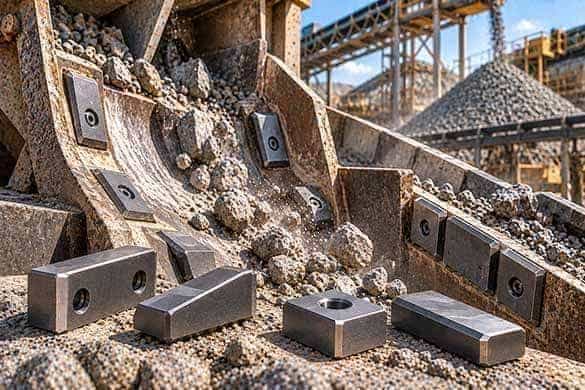
Learn how carbide grade selection, component geometry, mechanical support, dimensional tolerances, and surface finish influence the performance of wear components exposed to abrasion and impact.
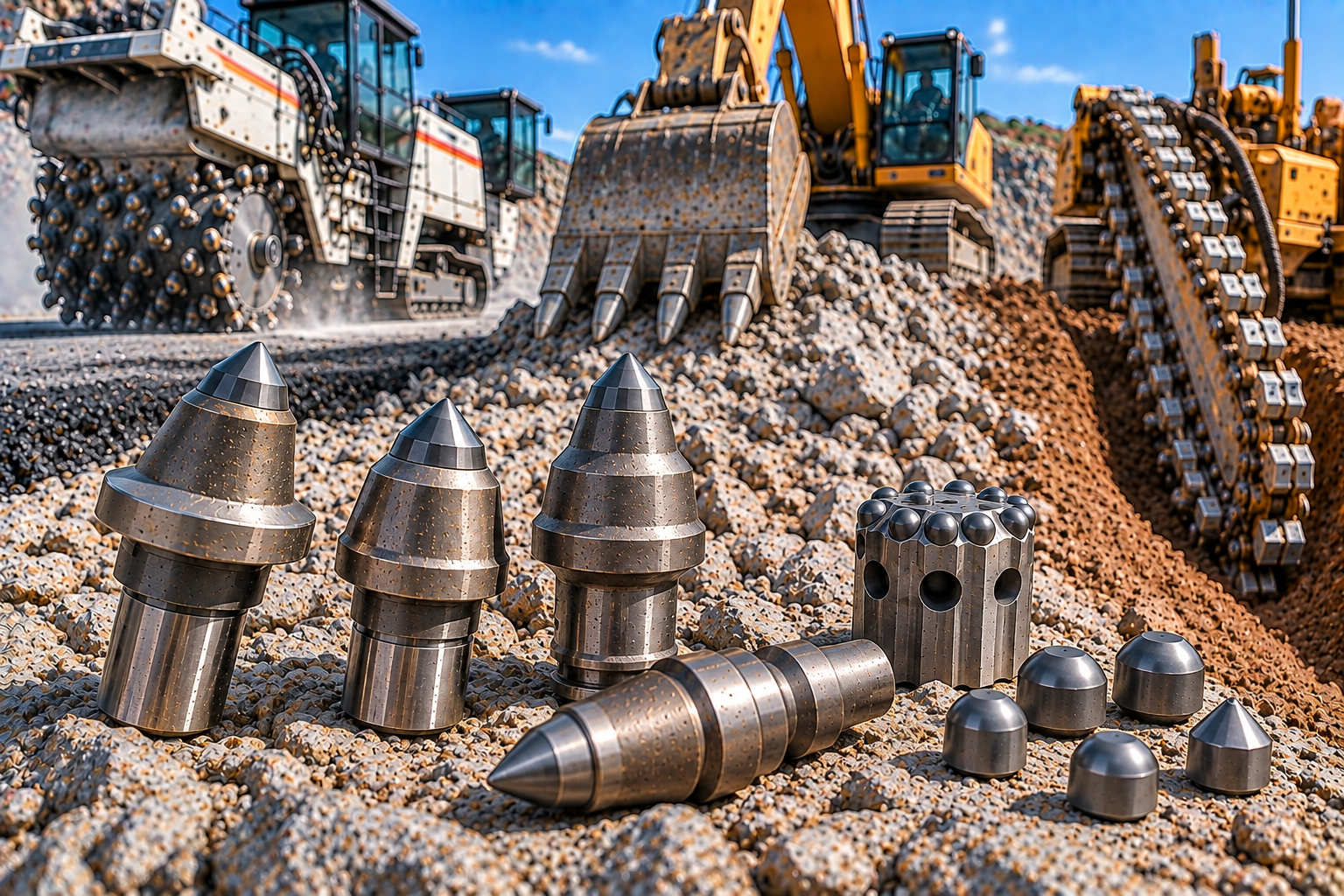
Explore how carbide tip and button geometry, grade selection, tool rotation, and mechanical support influence cutting performance in road milling, trenching, and rock excavation.
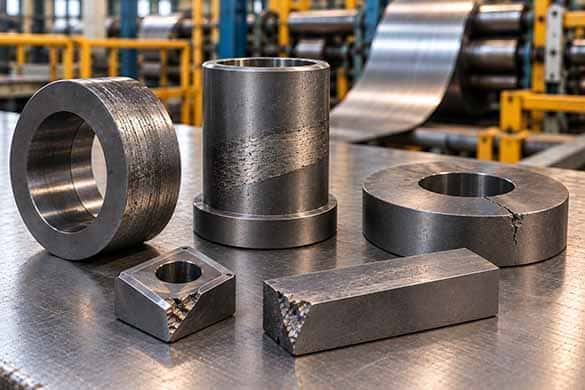
Understand how abrasion, adhesive wear, chipping, fracture, and thermal-mechanical damage affect carbide components—and how failure analysis guides grade selection and replacement design.
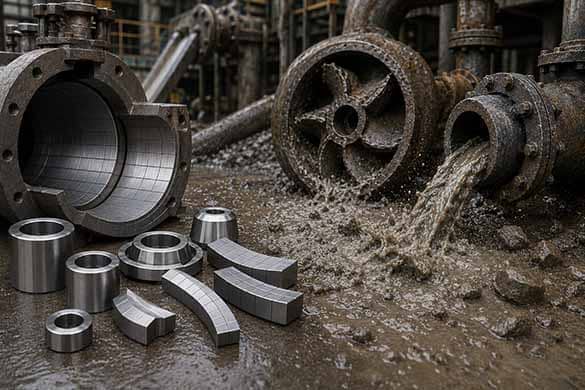
Learn how abrasive particles, slurry velocity, impact, corrosion, WC grain characteristics, binder systems, component geometry, and operating conditions influence cemented tungsten carbide selection for severe slurry wear applications.
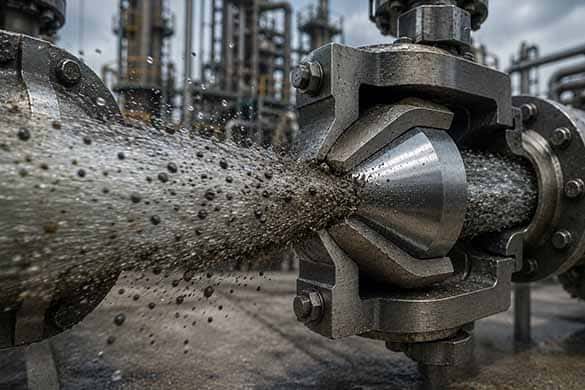
Learn how particle velocity, size, shape, impact angle, fluid chemistry, flow-path geometry, and localized erosion influence tungsten carbide grade selection and component design for high-velocity flow applications.
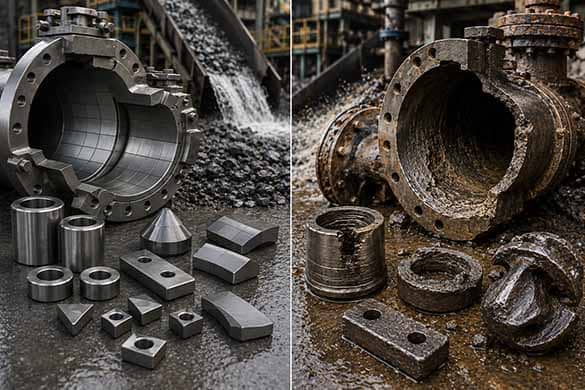
Compare tungsten carbide and steel for abrasive, erosive, and severe-service applications. Learn how wear mechanisms, mechanical loading, component geometry, operating conditions, and lifecycle cost influence material selection.
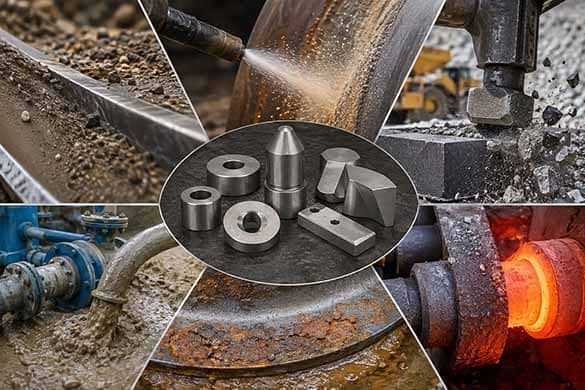
Learn how abrasion, particle erosion, impact, slurry wear, corrosion-wear, and thermal-mechanical conditions affect industrial components—and how identifying the dominant wear mechanism supports better material, carbide grade, and component design decisions.
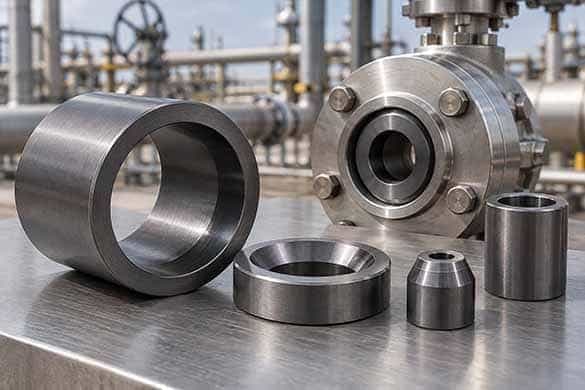
Explore how tungsten carbide’s material properties and component design support wear resistance and service life in demanding oil and gas applications.
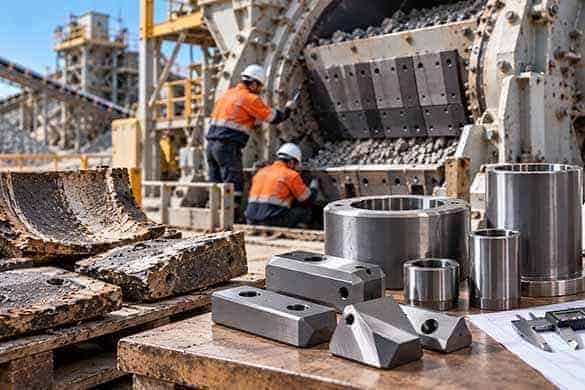
Learn how tungsten carbide components can reduce total cost of ownership by extending replacement intervals, reducing maintenance and downtime, and improving equipment availability in demanding wear applications.
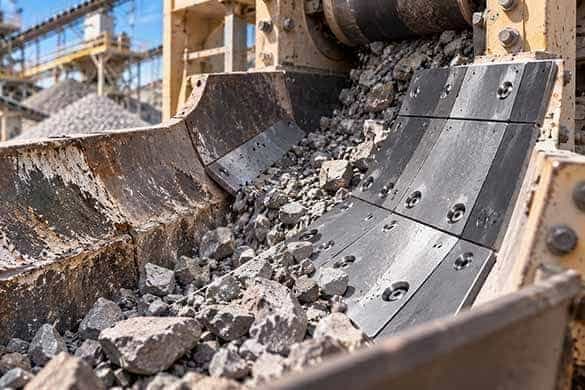
Learn how application-specific tungsten carbide grades, controlled manufacturing, and component design help resist severe wear, extend service life, maintain critical dimensions, and reduce maintenance and downtime.
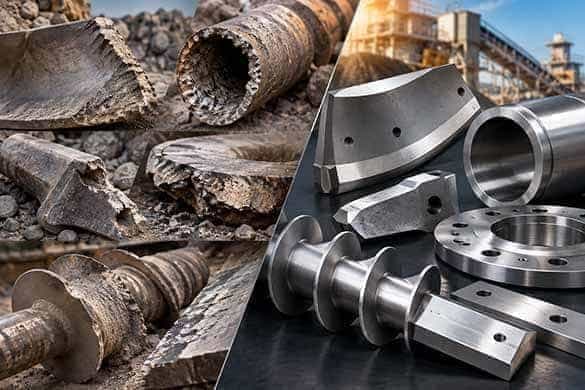
Learn why wear-critical components fail under abrasion, erosion, impact, thermal stress, and combined wear—and how application-specific tungsten carbide grades and component design can help extend service life and improve reliability.